
Your skin already knows. Now you do too.
The first mirror that speaks in numbers: a quick face scan, 10 skin metrics grounded in 31 studies, 30-day product experiments, daily routine tracking — and an AI advisor who truly knows your skin.
10 facial skin metrics, from your phone camera. The photo is not kept.


In an industry that sells dreams, we chose to sell measurement.
Worked to








How it works
No devices, no clinic, no guessing — just the camera already in your hand.
One selfie
The camera guides you to the right light and angle — and if the photo isn’t good enough, the app tells you exactly why (too dark, blurry, too far) and asks again. We never measure a photo we can’t trust.
A few seconds — and you have numbers
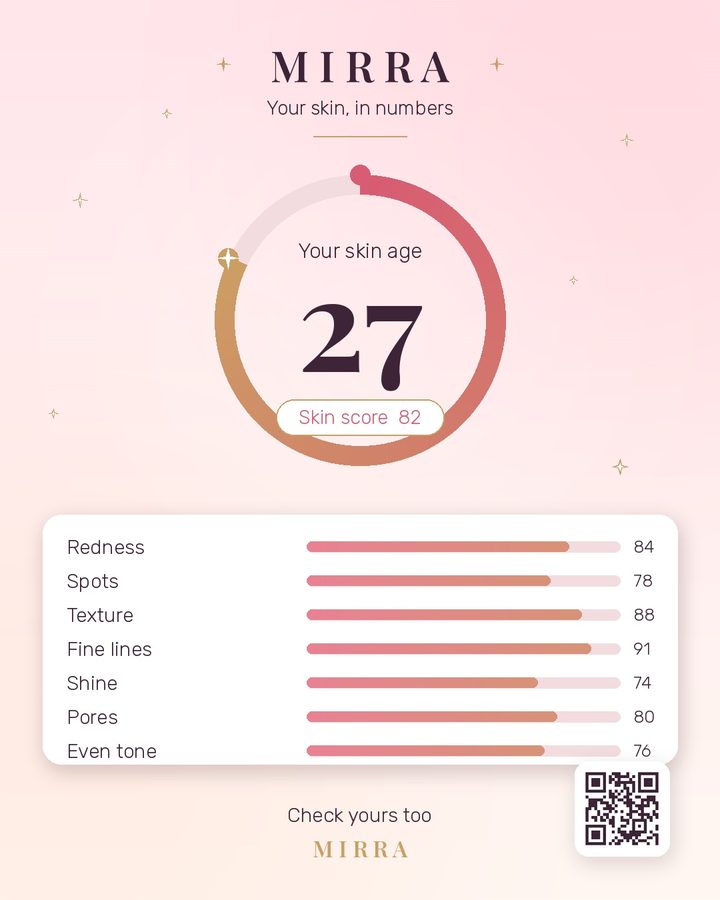
478 facial landmarks, 9 face zones, and 10 real color-and-texture metrics — topped with a skin score and skin age. Same algorithm, same thresholds, every day — so comparing days actually means something.
Track. Test. Know.
Graphs for every metric over time, a 30-day experiment for every new product, and an alert when something is hurting you — with the suspected product and the reason. In the end you know what works on YOUR skin, not on the skin of someone in an ad.
This is what it looks like

How to take a scan that works
The scan measures skin, not a photograph. Three things decide the result — the light, the distance and a second of stillness — and all three are yours to control.
What to do
Phone at eye level, about an arm away. Clean face, no make-up — it covers exactly what is being measured. Relaxed expression: a smile lifts the cheek into the nasolabial fold and moves the jawline more than anything else in the frame. Turn your head when asked, then a second of stillness — nine frames of one moment.
Where — the part that changes the most
Facing a window, in daylight. Even light on both sides: if one side is more than 22 units brighter the scan flags uneven lighting, and a small turn fixes it. Not with your back to the window — backlight pushes a quarter of the pixels out of measurable range. And no warm lamp in a room with daylight: two colours of light in one frame is the worst thing for the redness reading.
What to expect
Each metric sees a change at its own pace, and that pace is derived from its measured noise rather than chosen. Texture, dryness, unevenness, wrinkles and shine show a real change within a week of scanning. Spots, pores, dark circles, sagging and redness need a month or more — and for those, one scan’s number is a point on a graph, not an improvement.
One scan is a snapshot, not a conclusion. A longer scan only removes sensor noise; pose, expression and the room’s light are identical in every frame of it and come down only across scans. When a metric could not be measured in a given scan we say so, rather than showing a number that looks like all the others.
What else is here
Every claim on this page rests on something you can open and check.
Research-based. Not promise-based.
In a category that sells dreams, we chose to sell measurement.
31 scientific sources stand behind the system — skin colorimetry studies, a published study of AI grading against 50 dermatologists on over a thousand women, retinol and vitamin C trials, and the documented links between cycle, sleep, stress and skin. Every threshold and weight in the system cites its source.
Calibrated on 102 people photographed twice each, which gives every metric its own measurement error, its reliability (ICC, with a confidence interval) and the smallest change distinguishable from noise (MDC95) — and only a change bigger than that threshold counts as a change.
Three things you won’t find here: we won’t say "clinically proven" before we have our own validation study. We won’t confuse correlation (your daily graphs) with causality (a controlled 30-day experiment). And we don’t diagnose — for anything that looks medical, we warmly recommend a dermatologist.
Your face. Your data.
Sign in with Google or Apple: the app requires an account. Your password stays with them; we keep only the account’s ID and email address, so your history comes back to you on a new phone.
Your photos are kept while your account exists: from every scan we store the photo and a crop of your face. While you scan, the photos are also sent to Google Gemini, without your name. Deleting the account deletes them from our server right away.
Your data is never sold. The statistics we share with manufacturers are aggregate and anonymous only — never your face, never your personal data.
Full policy — what is collected, where it is sent, and how long it is kept ›
Your skin already knows. Now you do too.